
Refill or Exchange: The One Decision That Matters
Refilling usually gives you more propane for less money, while exchanging is faster and simpler when your tank is old, damaged, or expired. A standard 20 pound grill tank holds about 4.6 to 4.7 gallons when filled to its safe limit. Refill stations charge for the propane actually dispensed and fill the tank to that full amount. Exchange cages typically prefill their tanks to about 15 pounds, roughly 3.5 gallons, and charge a flat fee. You pay a convenience premium at the cage and leave with less fuel.
That does not make exchange a bad choice. If you are on a road trip, grilling tonight, or standing in front of a cage after hours, the speed is worth it. If you grill often or run a patio heater or RV, refill wins on value over a season. The rest of this guide helps you pick the right option for the tank in your hands.
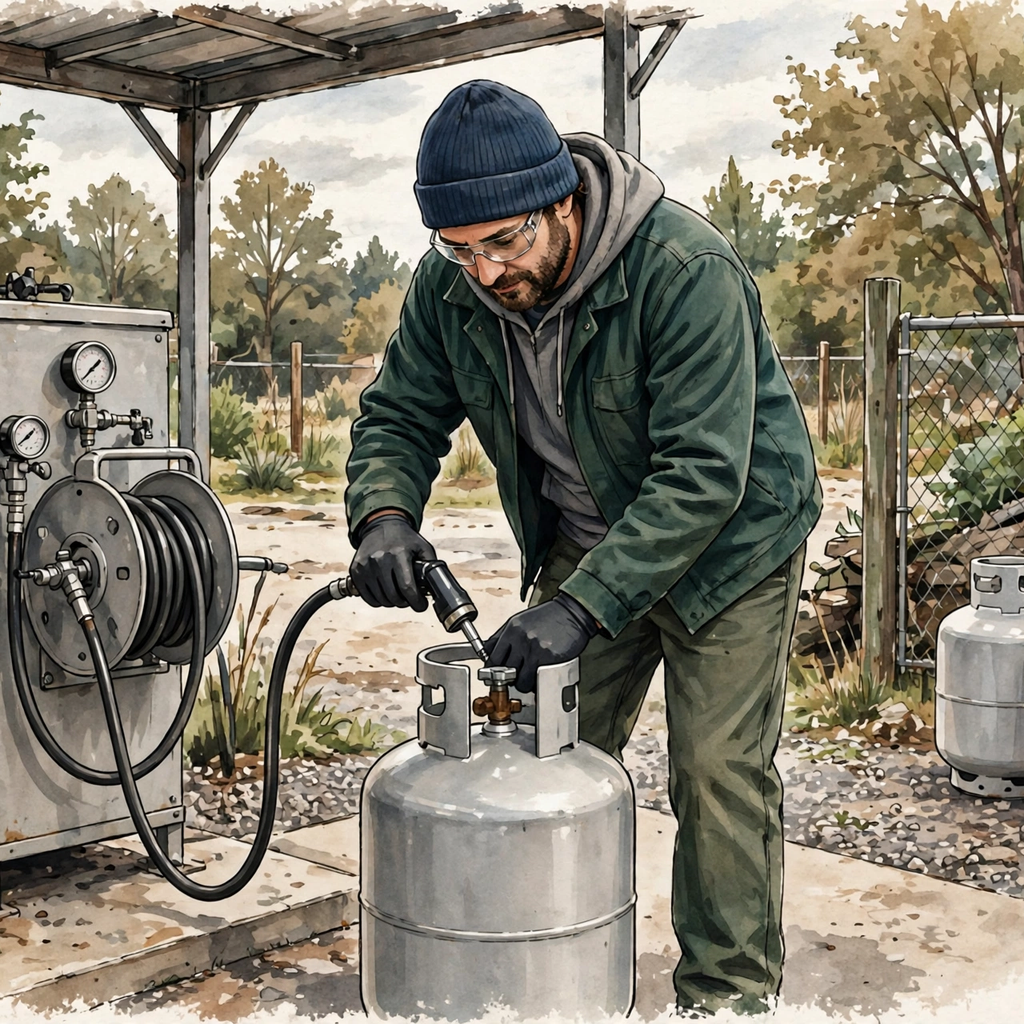
Where to Find Propane Refill Near You
Start with U-Haul, Tractor Supply, farm supply stores, hardware stores, and local propane dealers, and call ahead before you drive. Many of these locations have a trained attendant and a refill scale or meter, and they charge by the gallon. Some warehouse clubs also refill propane for members at low per gallon prices. Gas stations with an exchange cage out front do not always refill tanks, so check the sign or ask inside rather than assuming.
Search for propane refill plus your town name, then confirm three things by phone: they refill customer owned tanks, they are staffed to do it when you arrive, and they accept your tank size. A wasted trip with a tank in the trunk is the most common frustration in this whole errand. If you need fuel late at night, an exchange cage at a 24 hour store is the fallback. Our guide to 24 hour gas stations can help you find one open when you need it.
How to Check Your Tank Before You Go
Read the date stamped on the tank collar, look for rust, dents, and valve damage, and only bring a tank a refill station can legally fill. Portable propane cylinders generally need recertification 12 years after the manufacture date, then every 5 years after that. A refill station should refuse an expired or badly damaged tank. In that case exchange is often the cheaper fix, because you hand over the old tank and leave with a certified one.
Check the valve too. Modern grill tanks use an overfill prevention device valve, and the attendant will check it during the fill. Keep the tank upright in your vehicle, secure it so it cannot roll, and never transport a tank in a closed trunk for a long drive if you can avoid it. Ventilation matters, and a tank rolling around in the back is a hazard in a sudden stop.
Refill vs Exchange: A Simple Cost Comparison
Refill pricing is quoted per gallon, exchange pricing is a flat fee for a partially filled tank, so compare cost per pound rather than the sticker price. Refill prices commonly run about 3 to 4 dollars per gallon in many markets, which puts a full empty 20 pound tank at roughly 14 to 19 dollars. Exchange often runs about 20 to 30 dollars for about 15 pounds. Local prices vary by state and season, and propane tends to cost more in winter when heating demand rises, so treat these ranges as a way to compare options rather than a quote for your town.
One more refill advantage is topping off. If your tank is half full, a refill station adds only what you need and charges only for that. An exchange charges the full flat fee no matter how much fuel is left in the tank you hand over. Over a grilling season, that difference adds up fast. RV owners get a second benefit: many refill locations can fill mounted RV tanks and larger cylinders that exchange cages do not handle at all. Our RV friendly station guide covers stops that suit larger rigs.
How Long a Tank Lasts and How to Store It
A 20 pound tank gives a medium grill roughly 18 to 20 hours of cooking time, less on a large grill running on high. That is a planning number, not a promise, since burner count and heat setting change it a lot. Keep a spare tank if you grill often, and store tanks upright outdoors in a ventilated spot, never inside your home or garage for long term storage. Keep them away from ignition sources and out of direct sun where practical.
Never try to refill a tank yourself unless you are trained and equipped for it, and never use a tank that smells strongly of gas or shows valve damage. Propane has an odor added so leaks are noticeable. If you smell gas, move away, do not start a vehicle or light anything nearby, and call your local fire department or propane supplier for guidance.
Is it cheaper to refill or exchange a propane tank?
Refill is usually cheaper per pound, because you pay for the fuel dispensed and get a full tank. Exchange costs more per pound but is faster and solves the expired tank problem in one stop.
How much propane is in a 20 pound tank?
About 4.6 to 4.7 gallons when filled to its safe limit, which is 80 percent of the tank volume. Exchange tanks are typically prefilled to about 15 pounds, or roughly 3.5 gallons.
Can I refill an expired propane tank?
No, a refill station should refuse it. Get it recertified if it qualifies, or exchange it for a certified tank. The manufacture date is stamped on the tank collar.
Where is the cheapest propane refill?
Warehouse clubs and farm supply stores often post the lowest per gallon prices, but warehouse clubs require membership. Call two or three local refill stations and compare the per gallon price before you go.
Facts verified October 2026. Prices, hours, and refill availability vary by location and season.