Written and reviewed by: Gas Stations Near Me Editorial Team
Last reviewed: August 7, 2026
How This Guide Was Verified
This guide was reviewed using current information from the U.S. Energy Information Administration, U.S. Department of Energy, Federal Trade Commission, Google Maps, and established fuel-finder services Cheap Gas Station Near Me.
We check fuel-grade advice, pricing explanations, savings calculations, and driver-safety information against these sources.
We do not claim to have personally visited every listed station. Pump prices, fuel availability, opening hours, and station services can change without notice. Always confirm the final price and fuel grade at the pump.
Looking for affordable fuel nearby? Enter your ZIP code, city, address, or current location to compare gas station near me .
Do not choose a station based only on the lowest number shown. Check how recently the price was reported, the driving distance, fuel grade, payment requirements, and whether the station is open.
The best fuel stop is usually the one that saves money without adding an expensive or inconvenient detour.
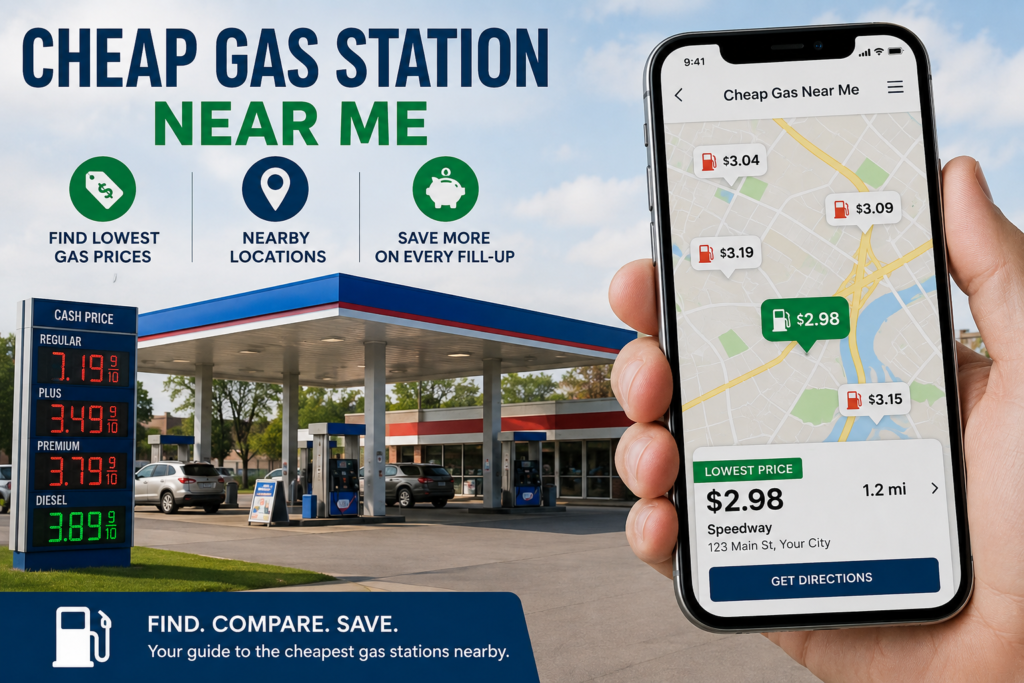
Can’t see the fuel finder?
Refresh the page, allow location access, or enter your ZIP code manually.
You can also browse these options:
- Gas stations within 1 mile
- Gas stations within 5 miles
- Stations open now
- Regular fuel prices
- Premium fuel prices
- Diesel prices
- E85 stations
- Fuel stops along your route
Turn these options into links to your relevant category, city, state, or locator pages.
Find the Lowest Fuel Price Near You
Start by entering your current location, city, ZIP code, or street address.
Select the fuel grade required by your vehicle before comparing prices. Regular, midgrade, premium, diesel, and E85 should not be compared as though they are the same product.
A useful station listing should show:
- Station name and brand
- Full street address
- Fuel grade
- Price per gallon
- Cash, credit, loyalty, or member-price conditions
- Time the price was reported
- Actual driving distance
- Open or closed status
- Available services
- One-tap directions
GasBuddy allows users to filter stations by price, distance, fuel type, brand, payment method, ratings, and amenities. Its support documentation also explains that active filters may hide some stations from the results.
Source: GasBuddy station search guidance
Check your selected filters when a station you know is missing.
The Cheapest Price Is Not Always the Cheapest Stop
A station may charge less per gallon but still cost more overall when it requires a long detour.
To calculate your possible savings, use this formula:
Gross savings = gallons purchased × price difference per gallon
Suppose you plan to buy 12 gallons and another station charges 10 cents less per gallon.
12 × $0.10 = $1.20 gross savings
You would save $1.20 before including the fuel used to reach that station.
Now calculate the detour cost.
Detour fuel cost = extra round-trip miles ÷ vehicle MPG × local fuel price
A lower sign price may not be worth it when the station is several miles away, traffic is heavy, or you must drive in the opposite direction.
The better option is often a station already located along your commute, grocery trip, school run, or road-trip route.
Calculate Whether a Longer Drive Is Worth It
Use these four numbers:
- The difference in price per gallon
- The number of gallons you plan to buy
- The extra round-trip distance
- Your vehicle’s average miles per gallon
Here is an example.
One station is 15 cents cheaper per gallon.
You plan to buy 14 gallons.
Your gross savings would be:
$0.15 × 14 = $2.10
The station requires four extra round-trip miles.
Your vehicle gets 25 miles per gallon, and fuel costs around $4 per gallon.
The fuel used by the detour would cost:
4 ÷ 25 × $4 = $0.64
Your estimated savings after the detour would be:
$2.10 − $0.64 = $1.46
This calculation does not include the value of your time, traffic delays, tolls, or waiting in line.
A small price difference usually matters more when you need a large fill-up or when the lower-priced station is already along your route.
How to Use the Gas Prices Map
A fuel-price map helps you understand how each station connects to the roads you are already using.
Follow these steps:
- Enter your current location or destination.
- Select the correct fuel grade.
- Choose a search radius.
- Check the time each price was reported.
- Compare road distance instead of straight-line distance.
- Check whether the station is on your route.
- Review the opening hours.
- Confirm cash, credit, loyalty, or membership conditions.
- Open directions before leaving.
Google says local search results are mainly based on relevance, distance, and prominence.
This means the first station shown on a map is not automatically the least expensive.
Source: Google Maps local ranking guidance
Google Maps may display fuel prices for some nearby stations, but coverage and freshness can vary.
Source: Google Maps fuel-price features
Always confirm the final amount when you arrive.
Nearest Station or Lowest Price: Which Should You Choose?
Choose the nearest suitable station when:
- Your fuel warning light is on.
- You are driving in an unfamiliar area.
- The price difference is only a few cents.
- The cheaper option requires a long detour.
- Traffic is heavy.
- You need only a small amount of fuel.
- The lower-priced station is closing soon.
- You are unsure how far the vehicle can safely travel.
Choose the lower-priced station when:
- It is already along your route.
- The price was reported recently.
- You need a large fill-up.
- The detour is short.
- The displayed price applies to your payment method.
- You already have the required membership.
- The station sells the fuel grade your vehicle needs.
Safety should come first. Do not keep driving on an almost-empty tank to save a small amount of money.
Compare Stations Within 1 Mile, 5 Miles, or Along Your Route
A one-mile search works well in busy neighborhoods, downtown areas, and situations where you need fuel immediately.
A five-mile search gives you more choices in suburban or rural areas where stations are farther apart.
A route search is often more useful than searching a wide circle around your location.
It helps you find fuel near the road you are already taking instead of sending you in the opposite direction.
GasBuddy provides a route-search option that allows users to enter a destination and find stations connected to the route.
Source: GasBuddy search-along-route instructions
For a road trip, compare:
- Distance from the highway exit
- Distance needed to return to the highway
- Fuel price
- Restroom availability
- Food and drink options
- Opening hours
- Diesel or alternative-fuel availability
- Space for trucks, trailers, or RVs
A station that looks close on the map may require a difficult turn, bridge crossing, toll road, or several miles of local driving.
Compare Regular, Midgrade, Premium, Diesel, and E85
Choose your fuel type before sorting the station results.
Regular Gasoline
Regular is normally the least expensive gasoline grade.
Use regular when it meets the octane requirement listed in your vehicle owner’s manual or fuel-door label.
Midgrade Gasoline
Midgrade has an octane rating between regular and premium.
Some vehicles recommend a particular octane level. Follow the manufacturer’s instructions instead of choosing by price alone.
Premium Gasoline
Premium fuel has a higher octane rating and normally costs more.
Higher octane does not automatically improve every vehicle.
The Federal Trade Commission has advised that drivers usually do not need premium unless the manufacturer requires or recommends it, or the engine has an octane-related knocking problem.
Source: Federal Trade Commission premium-fuel guidance
Do not pay more for premium simply because it sounds like a higher-quality product.
Diesel
Use the diesel filter when your vehicle requires diesel.
Do not rely on a station’s general gasoline listing because diesel prices can be different.
Confirm that the listed amount is for ordinary on-road diesel.
E85
E85 is intended for approved flex-fuel vehicles.
The U.S. Department of Energy provides a station locator for public E85 locations.
Source: Alternative Fuels Data Center E85 locator
Check your fuel door, owner’s manual, or vehicle manufacturer’s guidance before using E85.
Why Fuel Prices Change Between Nearby Stations
Two stations located only a few blocks apart may charge different prices.
The U.S. Energy Information Administration explains that retail gasoline prices are affected by:
- Crude oil costs
- Refining costs
- Distribution and marketing costs
- Federal, state, and local taxes
- Supply and demand
- Seasonal fuel requirements
- Regional fuel blends
- Local competition
Source: EIA factors affecting gasoline prices
A station’s individual price can also be influenced by:
- Rent
- Staffing costs
- Delivery expenses
- Traffic volume
- Nearby competition
- Store sales
- Loyalty discounts
- Membership requirements
- Local operating expenses
Prices may also rise temporarily because of refinery problems, pipeline disruptions, severe weather, supply shortages, or regional regulations.
This is why a national average can provide context but cannot tell you what a particular station will charge.
Find Affordable Fuel in Your City or ZIP Code
Enter your city, ZIP code, address, or current location to compare stations in your area.
Start with a one-mile radius when you need the nearest available pump.
Expand the search to five miles when you have enough fuel and want to compare more options.
For a longer trip, use the route-search feature instead of searching a wide circle around your current position.
Before choosing a station, compare:
- The correct fuel grade
- The time the price was reported
- Actual road distance
- Cash, credit, loyalty, or member conditions
- Current opening status
- The distance needed to return to your route
- Available amenities
- Traffic conditions
A station that appears close on a map may require a difficult turn, highway exit, bridge crossing, or travel in the opposite direction.
Use driving distance and directions rather than judging distance from the map alone.
For stronger local results, city and state pages should contain:
- Actual nearby station listings
- Addresses
- Recently reported prices
- Report timestamps
- Available fuel grades
- Open-now status
- Driving distance
- Directions
- Station amenities
- Cash or membership conditions
Do not publish fixed example prices unless they are connected to a reliable source and display a clear update time.
Check Wawa, Costco, Sam’s Club, and Other Brand Prices
Many drivers prefer a certain station brand because of rewards, membership savings, food, restrooms, or familiar services.
Useful brand filters include:
Check the conditions attached to each price.
Warehouse-club stations may require an active membership.
Some listings may show a loyalty price instead of the standard public price.
Other stations may charge different amounts for cash and credit-card payments.
GasBuddy notes that Costco and Sam’s Club locations may be hidden when certain payment, grade, distance, or other filters are active.
Source: GasBuddy station filter guidance
Reset the filters or search the map directly when a known station does not appear.
Check Cash, Credit, Loyalty, and Member Prices
A low listing can be misleading when it only applies to a special payment method or discount program.
The displayed amount may require:
- Cash payment
- A store loyalty account
- A linked payment card
- A car-wash purchase
- Grocery fuel points
- A warehouse membership
- An app offer
- A limited-time promotion
Every station listing should clearly identify the price type.
Recommended labels include:
Cash price
Credit price
Member price
Loyalty price
Driver-reported price
Station-confirmed price
Do not compare a discounted membership price with another station’s normal public price.
Before filling up:
- Check the price shown on the pump.
- Select the correct fuel grade.
- Confirm whether the discount was applied.
- Keep your receipt until the charge is correct.
Find Stations Open Now With the Services You Need
The lowest price is not useful when the station is closed or does not provide the service you need.
Useful filters include:
- Open now
- Open 24 hours
- Pay at pump
- Restroom
- Free air
- Car wash
- ATM
- Convenience store
- Food
- Truck access
- RV access
- Diesel
- E85
- Contactless payment
Opening hours and services can change.
A listing may say that a location is open 24 hours even when only the outdoor pumps remain available.
The convenience store, restroom, car wash, or service counter may have different hours.
Confirm important services before making a long detour.
How Fresh Is the Price You See?
Fuel prices can change several times within a short period.
Every displayed price should include the exact time or approximate age of the report.
Suggested freshness labels are:
Recently Reported
Reported within the last three hours.
Reported Today
Reported within the last 12 hours.
Older Report
Reported between 12 and 24 hours ago.
Verify Before Driving
Reported more than 24 hours ago.
These labels indicate the age of a report. They do not guarantee that the pump price has not changed.
A driver-reported system should also show:
- Which fuel grade was reported
- Whether the amount was for cash, credit, or members
- The report date and time
- Whether another user confirmed it
- The report source
- When the report expires
FuelHere separates its regional EIA benchmark from driver-submitted local pump prices and tells users to confirm prices at the station.
Source: FuelHere fuel finder
Clear source and freshness labels should be standard on any fuel-price website.
Is Low-Cost Fuel Safe for Your Vehicle?
A lower price does not automatically mean that the fuel is unsafe or unsuitable.
The main rule is to use the grade and octane rating required or recommended by the vehicle manufacturer.
The U.S. Energy Information Administration explains that gasoline is normally sold as regular, midgrade, and premium, based on octane rating.
Source: EIA gasoline price and grade information
Before filling the tank:
- Check the fuel grade.
- Confirm the displayed price.
- Look for cash or membership conditions.
- Make sure you are using the correct nozzle.
- Keep the receipt.
- Stop pumping if the equipment appears damaged.
- Inform station staff if the pump or nozzle appears unsafe.
Do not use premium as a general engine treatment when the vehicle does not require it.
Do not put E85 into a vehicle that is not approved for flex fuel.
Save More Without Driving Across Town
Finding a lower pump price is only one way to reduce fuel costs.
You may save more by:
- Combining several errands into one trip
- Filling up along a route you already use
- Avoiding unnecessary idling
- Accelerating and braking smoothly
- Removing unnecessary weight from the vehicle
- Keeping the vehicle properly maintained
- Using the correct fuel grade
- Checking tire pressure
- Comparing legitimate loyalty rewards
- Avoiding unnecessary high-speed driving
The Department of Energy says fuel economy normally drops quickly at higher speeds and that unnecessary idling uses fuel without moving the vehicle.
Source: Department of Energy driving tips
The Environmental Protection Agency also identifies aggressive driving, idling, vehicle condition, weather, and road conditions as factors that affect real-world fuel economy.
Source: EPA fuel-economy guidance
A smooth drive to a reasonably priced station may save more than crossing town for the lowest displayed price.
How Station Listings and Prices Are Verified
A reliable fuel finder should explain where each piece of information comes from.
Station Locations
Station names, addresses, coordinates, brands, and services may come from:
- Public mapping databases
- Station operators
- Licensed data providers
- Government datasets
- Community corrections
Individual Pump Prices
Local prices may come from:
- Station operators
- Data partners
- Driver reports
- Receipts
- Public price feeds
Every price should display its source type and update time.
Regional Price Benchmarks
The U.S. Energy Information Administration publishes weekly gasoline and diesel price information for the United States and major regions.
These figures are averages, not prices for an individual station.
Source: EIA gasoline prices and outlook
State and Metro Averages
AAA publishes national, state, county, and metro fuel-price averages.
These figures help drivers understand whether local prices are high or low, but they do not replace an individual station report.
Source: AAA fuel prices
Alternative Fuels
The U.S. Department of Energy’s Alternative Fuels Data Center tracks stations for fuels and energy types including:
- E85
- Biodiesel
- Renewable diesel
- Compressed natural gas
- Hydrogen
- Propane
- Electric charging
Source: Alternative Fuels Data Center
Corrections and Reports
Drivers and station operators should have a visible way to report:
- An incorrect price
- A permanently closed station
- A temporary fuel outage
- Wrong opening hours
- A missing fuel grade
- An incorrect brand
- An unavailable service
- A duplicate listing
- An incorrect address
- A payment-condition error
No fuel finder can guarantee that every displayed amount will match the pump.
The final posted station price controls the purchase.
How Often This Guide Is Reviewed
We review the guidance on this page at least once every three months.
We may update it sooner when:
- A government agency changes its fuel guidance
- A data provider changes its methodology
- A major station-finder changes its features
- New fuel types or filters are added
- A calculation or explanation needs correction
- Search or mapping systems change how station information is displayed
Station prices follow a separate update schedule.
Each listed station price should display its own report time because updating this article does not make an individual pump price current.
FAQS
How do I find the lowest fuel price near me?
Enter your location, city, ZIP code, or address. Select the correct fuel grade, sort the results by price, and check the report time, driving distance, and payment conditions before selecting a station.
Can Google Maps show fuel prices?
Google Maps may show fuel prices for some nearby stations. Coverage and update times vary, so confirm the final amount at the pump.
Is the nearest station always the least expensive?
No. The closest station may charge more for convenience. Compare both the reported price and actual road distance before choosing.
How far should I drive for a lower price?
Calculate the number of gallons you will buy, the price difference per gallon, and the fuel used by the extra round trip. A small discount normally does not justify a long detour.
Why is the cash price lower than the credit price?
Some stations offer a cash discount because card payments may create processing costs. Always check whether the displayed amount applies to cash or credit.
Why can’t I see a nearby Costco or Sam’s Club station?
Membership, payment, fuel-grade, distance, or other filters may hide warehouse-club stations. Reset the filters and search near the known location.
How often should station prices be updated?
Prices should be refreshed as often as the data source allows. Every listing should show the last report time. Reports more than 24 hours old should include a warning.
Can I find diesel or E85 nearby?
Yes. Select diesel or E85 before searching. Confirm that your vehicle is approved for the selected fuel type.
Why did the pump price differ from the online listing?
The report may be old, may show another fuel grade, or may apply only to cash, loyalty members, or warehouse-club members.
Are driver-reported prices accurate?
They can be helpful, but they are not guaranteed. Accuracy depends on the report time, fuel grade, payment method, and whether the station changed its price after the report.
Should I buy premium because it is better?
Use the octane rating recommended or required by the vehicle manufacturer. Premium normally costs more and may provide no benefit to an engine designed for regular gasoline.
What does “take me to the nearest gas station” mean?
It asks a navigation or mapping service to find a nearby station using your current location. The nearest result may not have the lowest price.
Is a station within one mile better than one within five miles?
A station within one mile is usually more convenient. A five-mile search gives you more choices, but the additional driving distance should be included in your savings calculation.
How can I find Wawa prices nearby?
Enter your location and apply the Wawa brand filter. Check the fuel grade, report time, payment conditions, opening status, and driving distance before leaving.
Are national fuel prices the same as local prices?
No. National and regional averages provide general context. Individual station prices vary because of taxes, supply, transportation costs, competition, operating expenses, and local market conditions.
What should I do when a station price is wrong?
Use the website’s correction or report option. Include the station name, address, fuel grade, actual price, payment type, and the time you checked it.
Can I search for a station along my route?
Yes. Use a route-search feature and enter your destination. This can help you find a reasonably priced stop without driving far away from your planned route.
Does the lowest price always save the most money?
No. The lowest displayed price may require a long detour, a membership, cash payment, or a large minimum purchase. Compare total trip cost rather than price per gallon alone.