
First, Get Safe. Then Worry About the Car
If your engine sputters and dies, steer to the shoulder or the nearest safe flat spot, turn on your hazard lights, and stay out of traffic. Coast as far as safety allows rather than stopping in a travel lane, and use your remaining steering and braking carefully since power assistance fades once the engine stops. On a highway, get as far right as possible, and on a busy road, keep everyone inside the vehicle if the shoulder is narrow or traffic is fast. Your safety matters more than the car in this moment.
Once stopped, assess where you are. A nearby exit or station you can walk to safely is the best outcome. A highway shoulder with no sidewalk is not a place for a long walk, especially at night or in bad weather. In that case, call roadside assistance, your insurer, or a friend, and wait in a safe spot. Tell the dispatcher your direction of travel, the nearest mile marker or exit, and the color and type of your vehicle.
What Running Dry Does to Your Car
Running out of gas once rarely ruins a car, but it can strain the fuel pump, pull sediment into the fuel system, and trigger a check engine light. Modern fuel pumps sit inside the tank and use gasoline for cooling and lubrication, so running dry can overheat the pump, especially if it happens repeatedly. Sediment that normally rests at the bottom of the tank can get drawn toward the filter when the tank is nearly empty. Diesel vehicles face a worse version of this problem, since air in the high pressure fuel system can require priming or bleeding before the engine restarts.
Most gasoline cars restart after a gallon or two is added, though it may take a few longer cranks to reprime the system. If the car still will not start after fuel is added, do not keep cranking until the battery dies. A clogged filter, a weakened pump, or an unrelated fault may need a shop. Our check engine light guide covers the simple causes to check first, and our bad gas symptoms guide covers what contaminated fuel feels like.
Your Options for Getting Fuel
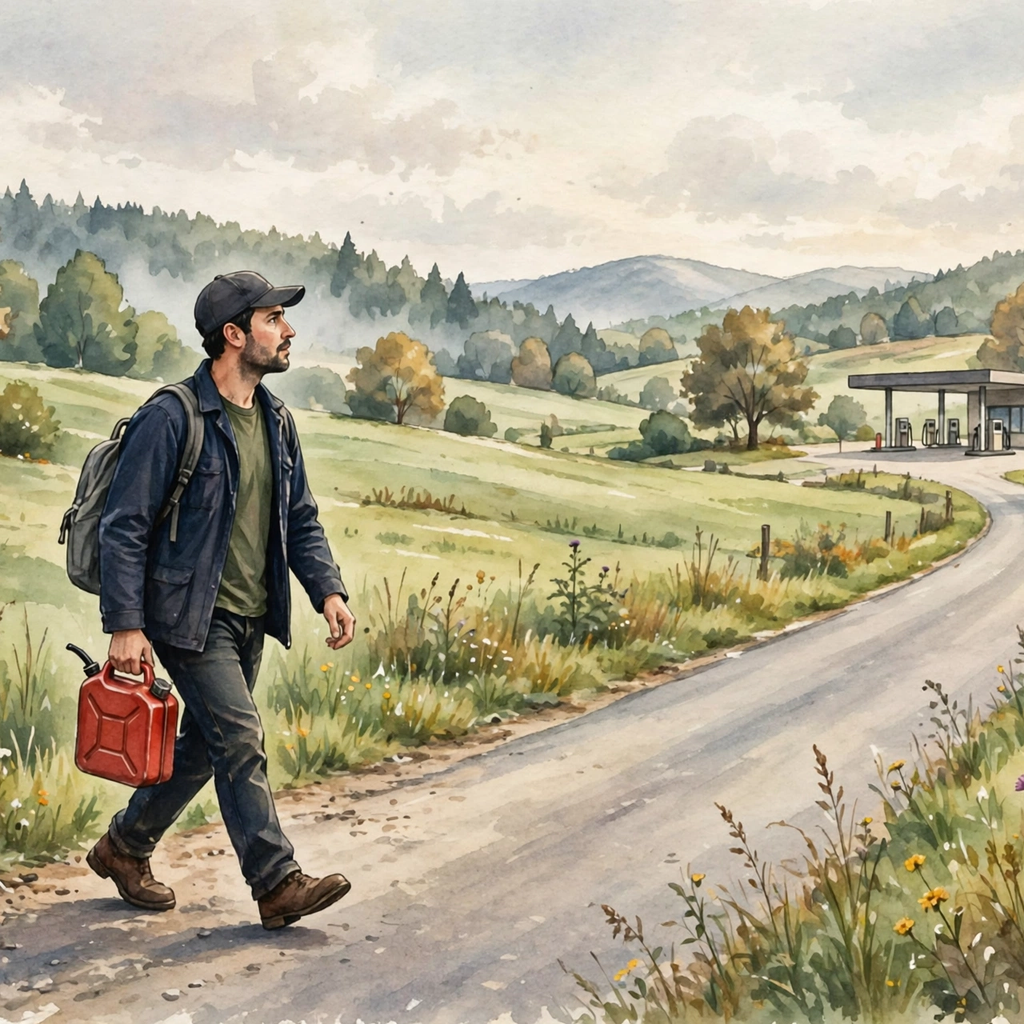
Walk to a station only if it is close and safe, call roadside assistance for a fuel delivery, or ask a passing driver or nearby business for help. Roadside assistance plans and many insurers deliver a small amount of fuel, often enough to reach the nearest station, though some charge a fee for the service. Carrying a small approved fuel container in the trunk can turn a long wait into a short walk, but only fill it at a station and secure it upright for the trip back. Never carry fuel in an unapproved container, and never ride with a loose fuel can in the passenger cabin.
Fuel delivery services exist in some cities through apps, but coverage is uneven and a highway shoulder is not a good delivery address. The reliable options remain the same ones drivers have used for decades: a safe walk, a phone call, or a tow to the nearest station. If the car is in a dangerous spot, a tow is cheaper than a collision, so do not hesitate to call one.
How Much Does It Cost?
The fuel itself costs little, but the rescue can cost a tow fee or a roadside service fee if you have no coverage. A gallon or two at the pump is the cheapest part of the story. Roadside fuel delivery is often free or low cost with a membership or insurance add on, and a short tow typically runs far more than the fuel. Repeat incidents cost more in the long run through fuel pump wear, so the real expense of running dry is not the rescue, it is the habit.
Check your policy before you need it. Know whether your insurer or auto club covers fuel delivery, how many calls a year are included, and what number to call. Save that number in your phone now, while you are calm and at home, rather than searching for it on a shoulder in the rain.
How to Make Sure It Never Happens Again
Treat a quarter tank as empty, learn your real range, and plan fuel stops before rural or highway stretches. Fuel gauges and range estimates are estimates, and they get less reliable on hills, in cold weather, and with a low tank. A quarter tank rule gives you a buffer for closed stations, detours, and bad estimates. On a road trip, note the distance to the next station before you pass the last one, and fill up when the gap ahead is longer than your remaining range plus a margin.
Use a price app to find stations ahead rather than hoping one appears. Our gas price app comparison and cheapest gas guide help you plan stops that are both cheap and actually on your route. Keep the tank fuller in winter, when cold starts and delays burn more fuel, and when a storm could close stations or block roads.
Will running out of gas damage my car?
Once is unlikely to cause major damage, but it can strain the fuel pump and stir up tank sediment. Repeatedly running dry raises the risk of pump failure and fuel system trouble.
How do I restart a car after running out of gas?
Add a gallon or two, turn the key to the on position for a few seconds to let the pump prime, then crank. It may take a few tries. If it still will not start, stop and call for help rather than draining the battery.
Does roadside assistance bring gas?
Many auto clubs and insurers offer fuel delivery as part of roadside coverage, often enough to reach the nearest station. Check your plan terms and save the number before you need it.
How low can I safely let my tank go?
Treat a quarter tank as your refuel point. Gauges and range estimates are approximate, and a quarter tank leaves room for detours, closed stations, and cold weather.
Facts verified October 2026. Costs and coverage vary by insurer, plan, and location.