Finding an E85 station is harder than it should be. Most gas station locators don’t filter by fuel type, and Google Maps results are often incomplete or outdated. This page gives you a live locator map sourced directly from the U.S. Department of Energy, a clear guide on whether your vehicle can use E85, and honest cost-per-mile math so you know if the switch actually saves you money.
There are currently over 4,200 public E85 stations near me across 44 U.S. states serving more than 20 million flex-fuel vehicles on the road. Here’s how to find the one closest to you.
Find an E85 Station Near You
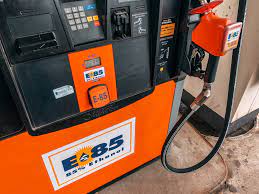
Use the locator below to find verified E85 flex fuel stations near your current location. The database is maintained by the U.S. Department of Energy’s Alternative Fuels Data Center and covers 4,200+ public stations nationwide.
Can’t find a station nearby? E85 is most widely available in Midwest states Iowa, Illinois, Minnesota, Indiana, and Nebraska have the highest station density. If you’re on the East or West Coast, use the DOE locator above to search along a route rather than by current location only.
Does Your Car Run on E85? Check in 60 Seconds
Before you drive to an E85 station, make sure your vehicle can actually use it. Only Flex-Fuel Vehicles (FFVs) are designed to run on E85. Using E85 in a standard gasoline engine can damage fuel lines, seals, and injectors so this check matters.
Here are the three fastest ways to confirm compatibility:
- Look at your gas cap Most FFVs built from 2008 onward have a bright yellow gas cap stamped with “E85/Gasoline” or “FlexFuel.” GM vehicles have used yellow caps since 2006. If your cap is yellow, you’re almost certainly good. Note: some Ford trucks shipped with black branded caps despite being flex-fuel, so the cap isn’t the only check.
- Check inside your fuel door Open your fuel door and look at the inside panel. A compatibility label will typically read “E85/Gasoline,” “Flex Fuel,” or “Unleaded Gasoline or E-85 Only.” If it says only “Unleaded Gasoline” with no E85 mention, your car is not an FFV.
- Look up your VIN The 8th digit of your 17-character VIN identifies your engine and fuel type. Common FFV codes include V, K, and L on Ford products, and 0, 3, C, D, K on GM products. Paste your full VIN into the free NHTSA decoder at vpic.nhtsa.dot.gov if it returns “Flexible Fuel Vehicle” under Fuel Type, you’re confirmed.
Your owner’s manual is always the definitive source. It will explicitly list approved fuel types and any special maintenance notes for ethanol use.
Common E85-Compatible Vehicles
| Make | Popular E85-Compatible Models |
|---|---|
| Chevrolet | Silverado, Tahoe, Suburban, Equinox, Impala, Trailblazer, Trax |
| GMC | Sierra, Yukon |
| Ford | F-150, Explorer, Taurus, Expedition |
| Buick | Encore GX, Envista |
| Dodge / Chrysler | Charger, Challenger, Chrysler 200, Grand Caravan |
| Toyota | Tundra, Sequoia (select years) |
| Nissan | Titan (select years) |
| Mercedes-Benz | C300, E350 (select years — check your fuel door label) |
This is not an exhaustive list. According to the EPA’s Fuel Economy Guide, Buick, Chevrolet, and GMC are the manufacturers currently offering new FFV models in the 2026 model year. Most other brands have shifted focus toward hybrid and electric vehicles, though millions of older FFVs from Ford, Chrysler, Toyota, and Nissan remain on the road.
Not sure if your specific model qualifies? Use the Alternative Fuel and Advanced Vehicle Search at afdc.energy.gov/vehicles to confirm by make, model, and year.
E85 vs. Regular Gas: Will You Actually Save Money?
This is the question that matters most. E85 is almost always cheaper per gallon than regular gasoline but E85 also delivers fewer miles per gallon because ethanol contains less energy than pure gasoline. Whether you come out ahead depends on the price gap and your vehicle’s efficiency.
Here’s the honest breakdown.
Current Prices (May 2026)
According to the Bureau of Transportation Statistics, the national average for regular gasoline in May 2026 is approximately $3.15 per gallon. E85 typically runs $0.50 to $1.00 per gallon cheaper than regular gas nationally, with the biggest discounts found in Midwest states where ethanol is produced locally. In Iowa, Minnesota, and Illinois, E85 is frequently priced between $2.50 and $2.90 per gallon.
The MPG Trade-Off
E85 contains roughly 75–80% of the energy of a gallon of regular gasoline. That means your fuel economy will drop when running E85 typically by 15–25% depending on the vehicle and driving style. The key question is whether the price discount is large enough to offset that efficiency loss.
The math using real numbers:
| Scenario | Fuel | Price/Gal | MPG (F-150 FFV) | Cost Per Mile |
|---|---|---|---|---|
| Regular gas | 87 octane | $3.15 | 21 mpg | $0.150 |
| E85 (Midwest) | E85 | $2.65 | 17 mpg | $0.156 |
| E85 (Coast) | E85 | $3.00 | 17 mpg | $0.176 |
What this means:
- In the Midwest where E85 is cheapest, the savings are close to break-even on a cost-per-mile basis and sometimes favorable
- In coastal states where E85 is less discounted, you may actually spend slightly more per mile on E85
- The savings are most significant when regular gas prices spike — when gas hits $4.00+, E85 at $2.90 becomes a clear winner
According to the Renewable Fuels Association, FFV drivers who actively choose E85 in favorable markets typically see a 12–15% reduction in MPG but pay 30–40% less per gallon, resulting in real per-mile savings.
Bottom line: E85 is worth using if the price at your local station is at least 15–20% cheaper than regular gas. Use the locator map above to check current prices at nearby stations before deciding.
One More Advantage: Octane Rating
E85 has an octane rating of 100–105, compared to 87 for regular gas and 91–93 for premium. Higher octane means better knock resistance, cleaner combustion, and in some performance-tuned FFVs, improved horsepower. If you own a truck or SUV with a high-compression engine, E85 can deliver a performance benefit on top of the price savings.
E85 Availability by State (2026)
E85 is widely available in the Midwest and increasingly common across the South and Mountain West. Availability is thinnest on the Northeast and Pacific coasts, though stations do exist in every major metro area.
The U.S. Department of Energy reports over 4,200 public E85 stations in 44 states. Here is a regional overview:
Highest Availability (500+ stations)
These states have the densest E85 networks — you’ll rarely need to go out of your way to find a station:
- Iowa — Over 300 stations; the heartland of U.S. ethanol production
- Illinois — Strong presence in Chicago metro and downstate
- Minnesota — Extensive network statewide
- Indiana — Well-distributed across urban and rural areas
- Ohio — Good coverage, especially in major metros
- Missouri — Strong in St. Louis and Kansas City corridors
Good Availability (100–500 stations)
- Nebraska, Wisconsin, Michigan, Kansas, Texas, Tennessee, North Carolina, Georgia, Florida
Limited But Present (Under 100 stations)
- New York, California, Virginia, Pennsylvania, Colorado, Washington — stations exist but are concentrated in specific cities. Plan your fill-ups in advance when traveling in these states.
Minimal or No Coverage
Six states currently have very limited public E85 infrastructure: Hawaii, Alaska, Rhode Island, Vermont, Connecticut, and Delaware. If you’re in these states, E15 (approved for most vehicles built after 2001) may be your best alternative fuel option.
Planning a road trip? Use the AFDC Station Locator (linked above) to map E85 stations along your route before you leave. You can search by zip code, city, or along a corridor.
Frequently Asked Questions About E85 Fuel
What is E85 fuel?
E85 is a blend of ethanol and gasoline containing between 51% and 83% ethanol depending on the season and region. The “85” refers to the maximum ethanol content. In summer months, E85 contains more ethanol; in winter, the blend is adjusted to aid cold starting and is sometimes closer to 51% ethanol. The primary feedstock for U.S. ethanol production is corn, making E85 a domestically produced, renewable fuel source.
Can I use E85 in any car?
No. E85 is only safe to use in flex-fuel vehicles (FFVs), which are specifically engineered with ethanol-compatible fuel system components including reinforced fuel lines, seals, and fuel injectors. Using E85 in a standard gasoline vehicle can degrade rubber seals, corrode metal components, and trigger check engine lights. Always confirm your vehicle is rated for E85 before using it. The three fastest checks are the yellow gas cap, the fuel door label, and a VIN lookup (see above).
How many E85 stations are in the US?
There are currently over 4,200 public E85 fueling stations across 44 U.S. states. The majority are located in Midwest corn-belt states Iowa, Minnesota, Illinois, Indiana, and Nebraska where ethanol is produced and the supply chain is shortest. The DOE Alternative Fuels Data Center maintains an up-to-date searchable database of every verified E85 station in the country.
Is E85 bad for your engine?
Not if your vehicle is a flex-fuel vehicle. FFVs are built with fuel system components specifically designed to handle high ethanol content. E85’s higher octane rating (100–105) actually promotes cleaner combustion than regular gasoline. However, using E85 in a non-FFV can cause serious damage high ethanol content attacks rubber seals, fuel lines, and other components not designed for it. Never use E85 in a standard gasoline vehicle.
Does E85 reduce fuel economy?
Yes, but by less than most people expect. E85 contains roughly 75–80% of the energy content of regular gasoline, so fuel economy typically drops 15–25% compared to running the same vehicle on 87 octane. The actual impact varies by vehicle type smaller, newer engines tend to see a 10–15% drop while older, larger engines may see up to 20–25%. The key is to compare cost per mile rather than cost per gallon to determine whether E85 saves you money.
Is E85 better for the environment?
Yes, meaningfully so. Because ethanol is derived from plant material (primarily corn in the US), it is considered a renewable fuel that recycles carbon from the atmosphere rather than releasing fossilized carbon. E85 produces up to 40% fewer lifecycle greenhouse gas emissions compared to regular gasoline. It also burns cleaner at the tailpipe, reducing some air pollutants in urban areas. For drivers who want to reduce their carbon footprint while continuing to drive a conventional vehicle, E85 is one of the most accessible options available.
What’s the difference between E85 and E15?
E15 contains 15% ethanol and 85% gasoline it is approved for use in virtually all vehicles built after 2001 and is sold at over 3,000 stations in 31 states. E85 contains up to 85% ethanol and can only be used in designated flex-fuel vehicles. E15 offers a smaller price discount but much wider vehicle compatibility. If your car isn’t a flex-fuel vehicle, E15 is the higher-ethanol option available to you.
Where can I find the cheapest E85 near me?
Use the DOE station locator map at the top of this page it shows current station locations and addresses. For real-time price comparisons between stations in your area, E85Prices.com (run by the Renewable Fuels Association) maintains a crowdsourced price database you can filter by state. GasBuddy also allows filtering by fuel type including E85 in many regions.
Also on This Site
- Diesel Gas Stations Near Me — Find diesel and truck stop locations near you
- Cheap Gas Near Me — How to consistently find the lowest gas prices in your area
- 24-Hour Gas Stations Near Me — Stations open around the clock
- Buc-ee’s Locations Near Me — Complete guide to Buc-ee’s travel centers